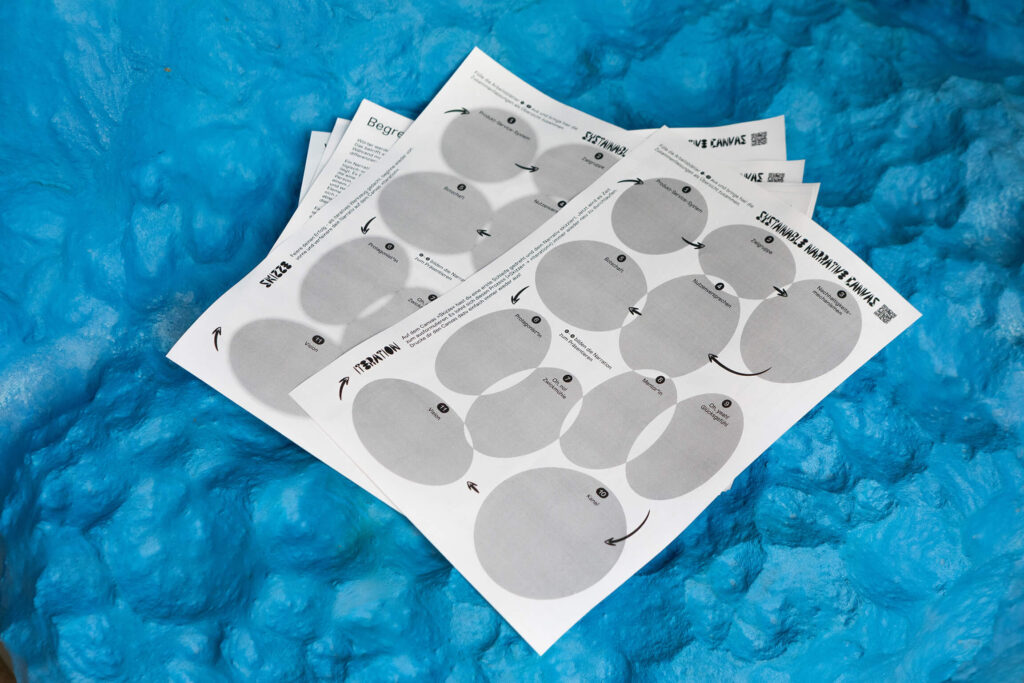
SUSTAINABLE NARRATIVE CANVAS
Miro Board (EN + DE)
PDF EN
PDF DE
Literatur
Ainslie, G. (1975). Specious reward: A behavioral theory of impulsiveness and impulse control. Psychological Bulletin, 82(4), 463–496. https://doi.org/10.1037/h0076860
Booker, C. (2006). The seven basic plots: Why we tell stories (Repr.). Continuum.
Bourdieu, P. (1984). Distinction: A social critique of the judgement of taste. Harvard University Press. (Original work published 1979)
Bourdieu, P. (1987). Die feinen Unterschiede: Kritik der gesellschaftlichen Urteilskraft (B. Schwibs & A. Russer, Trans.). Suhrkamp.
Campbell, J. (1949). The hero with a thousand faces. Princeton University Press.
Campbell, J. (2022). Der Heros in tausend Gestalten (M. Bischoff, Trans.). Insel Verlag. (Original work published 1949)
Desmet, P., & Fokkinga, S. (2020). Beyond Maslow’s pyramid: Introducing a typology of thirteen fundamental needs for human-centered design. Multimodal Technologies and Interaction, 4(3), 38. https://doi.org/10.3390/mti4030038
Enisman, M., & Kleiman, T. (2024). The relative difficulty of resolving motivational conflicts is affective context-dependent. Emotion, 24(6), 1358–1375. https://doi.org/10.1037/emo0001353
Gligorić, K., Anderson, A., & West, R. (2019). Causal effects of brevity on style and success in social media. Proceedings of the ACM on Human-Computer Interaction, 3(CSCW), 1–23. https://doi.org/10.1145/3359147
Haring, R., Kickbusch, I., Ganten, D., & Moeti, M. (Eds.). (2021). Handbook of global health (Vol. 3). Springer.
Hassenzahl, M., & Diefenbach, S. (2017). Erlebnis- und wohlbefindensorientiertes Gestalten: Ein Arbeitsmodell. In S. Diefenbach & M. Hassenzahl (Eds.), Psychologie in der nutzerzentrierten Produktgestaltung (pp. 89–119). Springer. https://doi.org/10.1007/978-3-662-53026-9
Jung, C. G. (1968). The archetypes and the collective unconscious (R. F. C. Hull, Trans.; 2nd ed.). Princeton University Press.
Krippendorff, K. (2006). The semantic turn: A new foundation for design. CRC Press. https://doi.org/10.1201/9780203299951
Krippendorff, K., Michel, R., Schneider, N. G., & Mueller-Stahl, K. (2013). Die semantische Wende: Eine neue Grundlage für Design. Birkhäuser. (Original work published 2006)
Lee, B., & Lee, W. (2004). The effect of information overload on consumer choice quality in an on-line environment. Psychology & Marketing, 21(3), 159–183. https://doi.org/10.1002/mar.20000
Lewin, K. (1935). A dynamic theory of personality: Selected papers. McGraw-Hill.
Lewin, K. (1935). A Dynamic Theory Of Personality, Selected Papers (D. K. Adams & K. E. Zenner, Trans.). McGraw-Hill Book Company, Inc. http://archive.org/details/in.ernet.dli.2015.86763
Liedtke, C., Kühlert, M., Huber, K., & Baedeker, C. (2019). Transition Design Guide – Design für Nachhaltigkeit. Wuppertal Institut für Klima, Umwelt, Energie. https://wupperinst.org/design-guide
Liedtke, C., & Welfens, J. (2025). Wohlstand in Zeiten des Übergangs: Eine Neuvermessung für eine nachhaltige Zukunft. oekom. https://doi.org/10.14512/9783987264153
Lyotard, J.-F. (1984). The postmodern condition: A report on knowledge. University of Minnesota Press. (Original work published 1979)
Mattenberger, M. M. (2021). Brandtelling: Storytelling, das Marken und Menschen verbindet. Campus.
McCarthy, E. J. (1960). Basic marketing: A managerial approach. R. D. Irwin.
Miller, D. (2008). The comfort of things. Polity.
Miller, D. (2010). Der Trost der Dinge (F. Jakubzik, Trans.). Suhrkamp.
Mulder, P. (2012). AIDA model. Toolshero. https://www.toolshero.com/marketing/aida-model/
Müller, M. (2019). Narrative, Erzählungen und Geschichten des Populismus. In M. Müller & J. Precht (Eds.), Narrative des Populismus (pp. 1–10). Springer. https://doi.org/10.1007/978-3-658-22374-8_1
Ōno, T. (1988). Toyota production system: Beyond large-scale production (N. Bodek, Ed.). Productivity Press.
Potting, J., Hekkert, M. P., Worrell, E., & Hanemaaijer, A. (2017). Circular economy: Measuring innovation in the product chain. PBL Netherlands Environmental Assessment Agency.
Reed, K., Hanzelin, G., Gonzales, R. M., & Fessinger, M. B. (2026). The power of victim narrative: Eponymous legislation increases voter sympathy and support. Psychology, Public Policy, and Law. https://doi.org/10.1037/law0000476
Schmidt-Bleek, F. (1994). Wieviel Umwelt braucht der Mensch? MIPS – Das Maß für ökologisches Wirtschaften. Birkhäuser. https://doi.org/10.1007/978-3-0348-5650-8
Sheth, J. N., Newman, B. I., & Gross, B. L. (1991). Why we buy what we buy: A theory of consumption values. Journal of Business Research, 22(2), 159–170. https://doi.org/10.1016/0148-2963(91)90050-8
Shove, E., Pantzar, M., & Watson, M. (2012). The dynamics of social practice: Everyday life and how it changes. SAGE. https://doi.org/10.4135/9781446250655
Sinek, S. (2011). Start with why: How great leaders inspire everyone to take action. Portfolio.
Tochtrop, C., & Jessen, D. (2022). Designing futures with pasts: Rediscovering and transforming abandoned paths of food preservation under today’s paradigm of sustainability. Edinburgh Architecture Research Journal, 37, 49–69. https://doi.org/10.2218/ear.2022.6648
United Nations. (2015). Transforming our world: The 2030 Agenda for Sustainable Development. https://documents.un.org/doc/undoc/gen/n15/291/89/pdf/n1529189.pdf
United Nations. (2023). Communications materials: Sustainable Development Goals. https://www.un.org/sustainabledevelopment/news/communications-material/
VDI. (2001). VDI 2519 Blatt 1: Vorgehensweise bei der Erstellung von Lasten-/Pflichtenheften. Beuth Verlag.
Voros, J. (2004). A generic foresight process framework. Foresight, 5(3). https://doi.org/10.1108/14636680310698379Zimmermann, V. E. M., Maurer, H. T., & Kenning, P. (2026). Sustainable marketing: Konsumwerte als Hebel der Nachhaltigkeitstransformation. In A. Büttgen, E. Hackspiel-Mikosch, C. Liedtke, & T. Wilkening (Eds.), SDG 12: Nachhaltiger Konsum und nachhaltige Produktion (pp. 1–19). Springer. https://doi.org/10.1007/978-3-662-70118-8_32-1